Rabbit Carpaccio

DSC_0009Some people get cravings for carbs, I get cravings for raw meat. That’s why I was super excited to try a rabbit carpaccio dish ever since I started raising my own rabbits. The loin cut is such a tender and finely-grained morsel that I always feel absolute simplicity is best. There is nothing much simpler than this recipe and it is so fresh and delicious. I also call it rabbit sashimi and the flavor and texture reminds me of a mild raw tuna. Sushi lovers will appreciate this dish.

Rabbit Carpaccio

1 Fresh rabbit loin
Half a lemon
Salt to taste
Extra virgin olive oil

Remove the silverskin from the loin and slice it thinly. Place the slices in a single layer on a plate and sprinkle with salt. Squeeze on lemon juice and drizzle with olive oil. Serves 4 to 6 as appetizers.

DSC_0009

Amazing Turmeric

I sure wish I had known more about healing herbs and plants when I was growing up, it sure would have saved me a lot of money, time and hassle. After trying more and more natural cures, I don’t understand how certain commercial products can be so popular. So many of them just don’t work. There are things that do work though, and they work very well. They are also cheap and may already be lurking in your spice cabinet.

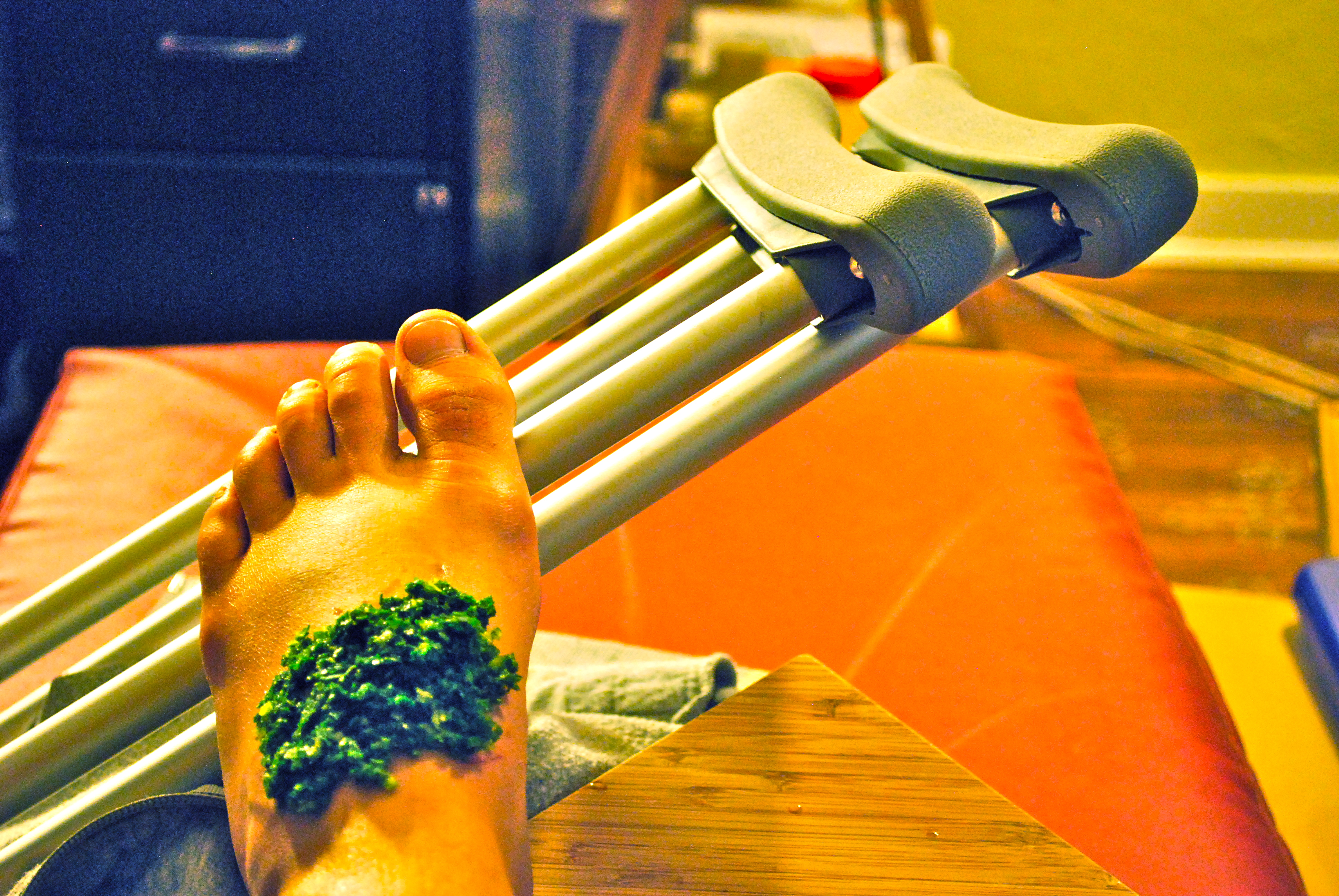
DSC_0074I recently learned about turmeric while I was researching ways to heal my broken foot faster. Turmeric has many healing properties, but my current favorite uses are for acne and for wounds. Not just human wounds, but poultry and livestock wounds as well.

I already had a little turmeric in the pantry for use in making curries. Recently at the Superstore I saw them selling it in kilo bags. Really? Who needs that much turmeric? Well, if they’re selling it someone must be buying it. It was cheap. I had been reading about its many uses. I bought a package and brought it home.

It turns out I needed it almost right away. I have three young Muscovy ducks that are in the process of growing up to become new breeders. I had them separated from the main coop but decided to try to integrate them since they were getting pretty big. It turns out the chickens decided that it would be fun (and tasty) to peck out the pinfeathers coming in on their tails. After just one day all three ducks had big, bloody holes in their tails and it was obvious they needed to be separated again. The wounds looked very nasty and I didn’t want them to continue to pick at each other after they were separated, so I made a quick, runny paste with olive pomace oil and turmeric and slopped it all over their tails. I had read it worked well for open wounds. The ducklings all calmed down immediately like they felt relief from the pain. The next day, the wounds looked amazing. They were not red or angry and they looked like they had dried out and closed up almost completely. The color seemed to discourage any more picking. Turmeric and oil is now my go-to remedy for any poultry wounds. It’s amazing.

My second favorite use is for acne. I suffered a lot from acne as a kid and eventually had to go on Accutane to calm it down. I still get a few zits on my face now and then, usually right before my period. Generally they are of the blackhead/whitehead, raging red and angry type that I can’t leave alone because they look gross and hurt. Despite better judgement I usually try to squeeze these things to relieve the pain and of course this usually makes them worse. They weep and will sometimes resist healing, forming a new zit in the same spot. Until now I used my favorite (pre-turmeric) remedy, Polysporin; which works well for a lot of stuff but somehow not for zits. I think by keeping the area moist it’s counterproductive.

Well, the cure my friends is turmeric. Make a paste of water and turmeric and put it right on your zit. You will feel a warming sensation and any pain will instantly recede. If you have popped a zit and it is weeping, dot some dry turmeric on the spot. It will stop the weeping and calm down the redness and pain. You will be left with a small, dried-out spot that will heal very quickly. The only side effect is your fingertips and sink/washcloth may stain yellow. It will stain your face a little as well, but I’ve found this not to be noticeable enough to care about. Seriously, if you have acne problems, you need to try turmeric. It will change your life.

Down to Nine

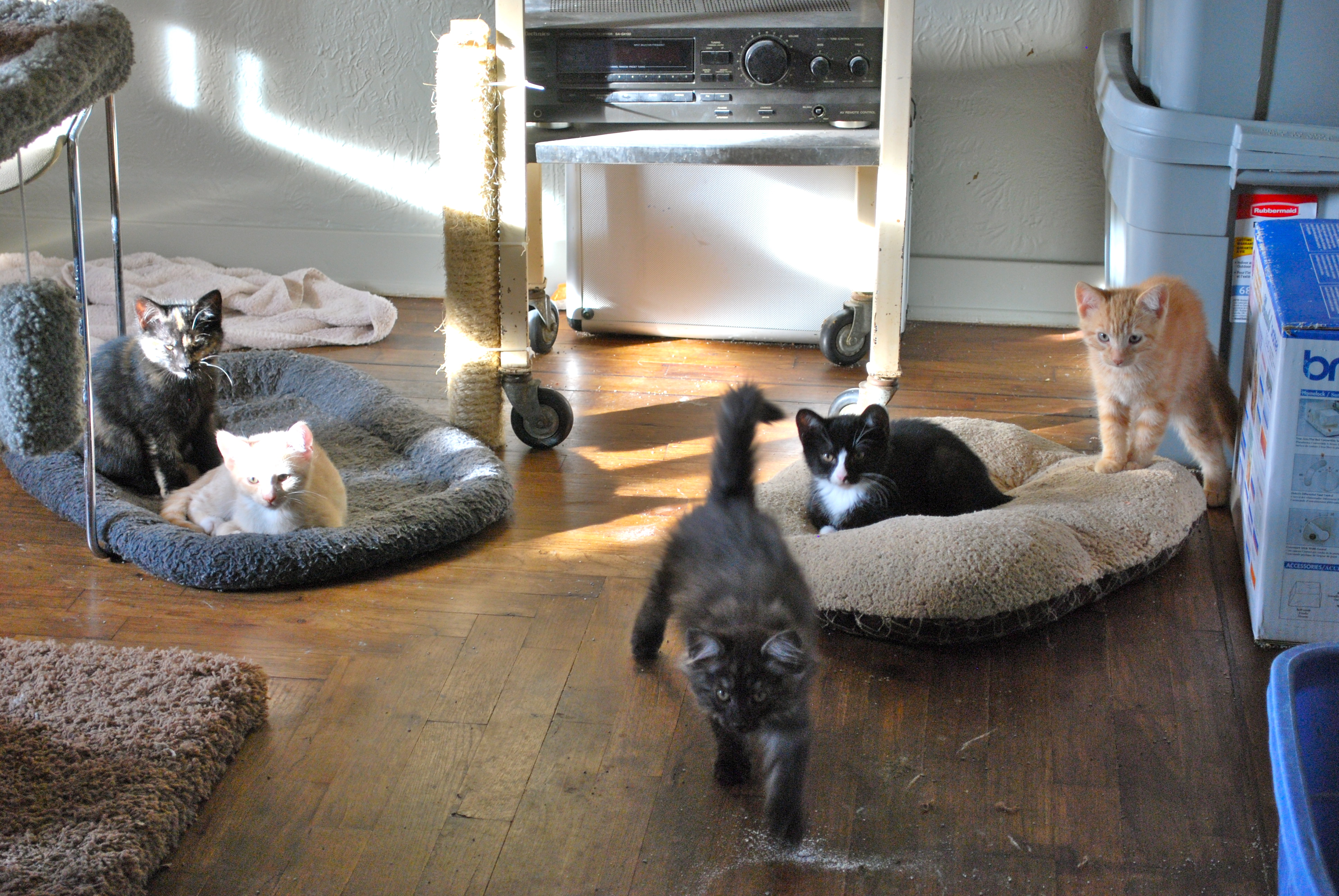
DSC_0021Well, the lone sweet girl kitten was escorted to her new home today, a day shy of 14 weeks old.

This was hard for me, since I have become attached to all of the kittens, but the little girl especially so. She was the first one to begin following me around dutifully at about three weeks old, much sooner than her brothers could even really walk. Whenever I would talk to the kittens, she would come running, thinking I must be talking to her. She was my little shadow who liked to lick drips of water from my fingers. She was the smallest of all the kittens and her voice was but a squeak.

I am heartened by the fact that she will be living a life much better than I could give her. She now resides in a big, beautiful home on a very quiet street with a huge property backing on to a bird sanctuary. She will grow up with three very calm and gentle kids, another young rescue cat, and two dogs. One of which is reported to enjoy cuddling kittens. She will get to know chickens and ducks and be with her children all day since they are homeschooled. She seemed very pleased to be there and I’m sure they’ll take excellent care of her.

I really am so glad I decided to have all the kittens fixed before bringing them to their new homes. It was expensive, but they have all healed so incredibly quickly and well that I would not hesitate to do it again. They were done at about 13 weeks old and all were over three pounds. It gives me such peace of mind knowing for sure that the cycle of kittens has stopped here. There are so many deserving homeless cats already.

Two of the boy kittens are scheduled for a trip to their prospective new homes in Victoria on Saturday. I’m hoping these homes will be just as good as the first one and I can leave them knowing I’ve done the best I could to get them started in their new lives. I know that they’ll bring a lot of joy to their new families.

Disciplining Kittens

Disciplining kittens is a touchy subject, but the reality is that kittens need to be properly introduced to gentle discipline in order to live safe happy lives while respecting their owners’ homes. Allowing your kitten to run wild without check is potentially asking for trouble later when he grows into a cat. It makes it much harder to introduce the whole concept of “no”, which will inevitably come up at one point or another.

DSC_0012Kittens are naturally very active, curious and adventurous. This is all part of learning to survive in the world as a full-blown cat. They will climb, chew, get into things, knock things over and scratch things. It may seem impossible to teach that flying bundle of fluff which things in the home should be left alone, but with a few techniques used consistently, they will eventually learn. You’ll never be able to keep a kitten or cat away from something he really wants to do, but at least he’ll understand it’s not an activity you accept and he’s a naughty cat when he does it.

First off, you must provide your kitten with things he is allowed to scratch, climb, chew and get into. A large, stable scratching post is an excellent investment in your cat’s happiness, and in turn yours. He will soon figure out that it offers height, exercise and entertainment, and that getting in trouble over scratching your furniture just isn’t as worth it. Toys can be as simple as cardboard boxes with holes cut into them, crumpled balls of paper or foil or paper or plastic bags.

DSC_0073Scratching furniture or climbing to forbidden areas

If your kitten has climbed to an area he should not be, or is scratching an object he should not, tell him “no” firmly or make a “shht” sound, then promptly go and pick him up and place him as far away as possible in another room on top of an object he must descend or escape from. My favorite, the very top level of their six-foot scratching post. You could also place him on the floor and cover him with a small blanket or put him in a little cardboard box. I like to tell them at this point that they have now been placed in the “punishment spot”.

The kitten will then be forced to tackle this obstacle and make his way back in order to try the naughty activity again, and this will often dissuade him after a few attempts. If your kitten is still quite small, you can scruff him gently when you remove him and always be sure to place him in a location where he cannot get hurt making his way back, no matter what his age. Scruffing them kind of drives the point home that you aren’t pleased, but when they get too big it becomes too uncomfortable for them. I have found that kittens get the point very quickly with this method.

Always be gentle with your kitten in order to avoid scaring them, but be swift with your motions. Be sure your kitten is getting enough attention and playtime from you or they may learn to be naughty on purpose just to get some interaction.

DSC_0036Whining and crying

If your kitten is crying, something may be wrong. Always be sure to check on your kitten if in doubt. Otherwise, you don’t want to run to soothe your kitten every time they begin to cry. Allow them to take a break and then go to see them once they’ve quieted a bit. This gives them a chance to calm down and soothe themselves, which will make for a less neurotic adult cat. It also cuts down on being verbally bossed around by your cat later on, which can sometimes be hard to live with.

A final tip

A cat’s world is comprised primarily of odors. Your new kitten will be adjusting to the strange new smells of your home and family as well as being suddenly away from his mother and siblings. If possible, bring something from his old home that has his mother’s scent on it, like a small blanket or piece of fabric that the mother has been allowed to sleep on. Put this in the kitten’s new bed and it will help to comfort them through the transition.

If you want a truly well-socialized kitten with the lowest level of stress upon transitioning to your home, adopt one that has been with its mother for 12 weeks or more. In a good environment, a kitten matures and gains a lot of confidence around this time and is much more ready to go and begin a new life with you with minimal issues.

Raw Feeding Kittens and Cats

Ever since I got my three sister cats as tiny, supposedly 8 week old kittens about five years ago, I have tried to feed them raw as much as I can.

Long story short, their much-loved kitty predecessor died at the young age of six from undiagnosed diabetes and acute renal failure and I strongly suspected her commercial, “high-quality” dry kibble diet. I wanted to make changes to fresher foods with my new girls, like I was doing in my own life with good results.

No, I do not spend a fortune each day feeding pre-prepared raw. I make my own!

DSC_0009I’d like to emphasize that you have to do your research with homemade raw cat food diets. They don’t have to be perfect, just as your own or your children’s diets are not perfectly balanced at every meal, but they absolutely must provide certain key elements.

I bought an electric meat grinder, found a great site online with a great recipe, and I’ve adapted it over the years to fit my cats and my budget. I’ve found that a homemade raw diet can be slightly cheaper than a good-quality, grain-free commercial canned food diet, although preparation time is a factor. I do still offer store bought canned food sometimes, and I do get lazy and give them a kibble meal sometimes, but I strive to keep cat kibbles strictly in the treat zone, where they belong. Even the most expensive “doom pellets” make excellent, low cost treats!

Well, of course I couldn’t resist starting this hard-luck litter of kittens on raw food right from the start. At this point in my life I don’t think I could bring myself to offer kibble to a small kitten. It would be like offering McDonalds to a baby.

Let’s be clear here: High quality commercially produced dry cat food is made from meat and byproducts (both generally fine), vegetables and (often) grains, all cooked at very high temperatures and coated with fat to make them palatable. Cooked food may taste good but it isn’t a natural primary diet for a cat.

Think about how convenient dry foods are. They require no refrigeration, no preparation. It’s the cat equivalent of a meal replacement bar. How would you feel about eating a big bowl of the same room-temperature, dry, possibly rancid, super-processed nuggets every day? These are completely dead foods that include significant proportions of things like vegetables and grains that cats cannot digest. They might as well be adding sawdust. Some probably do… Cellulose, right?

Cats are true carnivores and only need to eat meat. In the wild they catch and eat small animals, a diet very high in moisture. Cats evolved in the desert, and naturally have a very low thirst drive since they are accustomed to getting most of their moisture from their food. A healthy cat on a healthy diet never drinks much water at all.

Ok so, I’ve had these kittens since they were three days old. I was a little nervous about offering them my humble homemade cat food. Would they hate it? I had already been feeding the mother cat raw from nearly the start. She arrived with a bad case of diarrhea and did not produce a solid stool until I did so. Luckily she was totally into it and now has well-formed, firm stools. She’s a real wild girl who knows what’s good for her.

Benefits to Raw Feeding:

-Improved overall health, energy and longevity, shiny coat
-Vastly improved tooth and gum health, more natural eating motions, less bad breath
-Improved and reduced stool formation. Small and dry crumbly stools with no odor
-Improved mental stimulation when eating, each meal is different and fun to eat
-Sufficient hydration is maintained
-Wash glass jars instead of tossing cans

I noticed a couple of the kittens sampling the mama’s raw food at about week three. They were keenly interested in it. I had been adding water to make it soupy for them, but I don’t go out of my way to serve it warm. One kitten was gumming a piece of bone-in rabbit ribs for a good ten minutes while I watched. With no teeth yet it was a futile endeavor, but I was pleased with his enthusiasm.

At some point as kittens grow you may begin to worry that perhaps you should just leave out a bowl of kibble. Let me tell you, I’ve had this feeling. What if the babies get hungry between meals? The truth is, if you care about your cats then you’ll feed them regular meals and they will never go hungry for long. Cats were not made to eat all day long. They are made to catch a meal, eat that meal, and then let the gut clean itself out until the next meal. I would never go back to the All-Day-Kitty-Buffet. And it sounds funny, but it’s actually not funny at all, because my kitty died from it. Every cat out there is “doing fine” on their kibble diet until they’re not.

At week four, four of five kittens were eating the raw food meals and enjoying them very much. Now they all love it and much prefer it to all else, especially the batches made with fresh home-grown rabbit.

I feed about 3 to 4 big meals a day, (about 1.5 cups for 5 kittens and one momma) for the first four or five weeks, then reduce to two meals a day with fresh water always available. Use your own best judgement and keep in mind that kittens need to eat more frequently than adults. The momma cat is very helpful, she lets me know very clearly if it’s been a little too long between feedings.

The new chicken, rabbit and turkey formula seems to be a big hit. It’s very satisfying to be able to use my own rabbits and eggs to feed my precious cats. I love knowing exactly where the food has come from, down to the last detail. Today many bunny spines and other bones were ground up for them.

We do not waste a single bit of our rabbits. Literally, nothing is thrown away or even makes it as far as the compost, other than boiled bones. Everything is consumed by either human, dog or cat.

I’ll provide my catinfo.org inspired recipe in an upcoming post.

And One More Makes Ten

DSC_0007Yes, I am now caring for ten cats. My three cats, the five kittens who are almost ready to be rehomed as soon as I can get them fixed, the momma cat, and this little guy who showed up about a week ago.

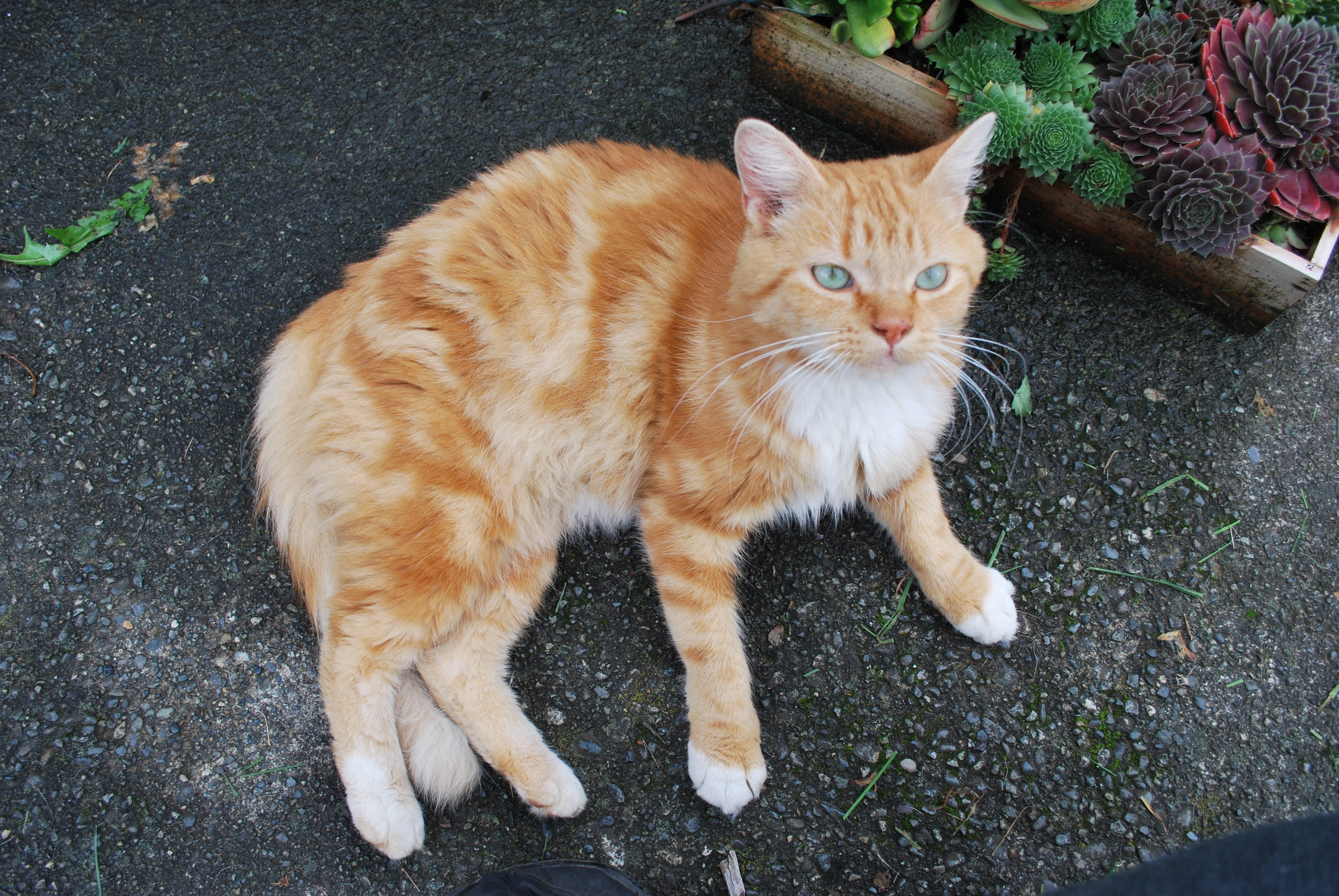
Meet Fred. Or Fritter as I’ve been calling him today. I noticed him for the first time in the neighborhood about three or four weeks ago. He was running around looking very panicked and confused. I’ve seen him here and there since then, always looking very scared. Then about a week ago as I was doing my farm chores, he decided to make friends with me. He was very timid at first but he was hungry and lonely and once he figured out I wasn’t going to hurt him, he couldn’t get enough petting. He was obviously someone’s pet at one time and I assume he was dumped here. Sadly, this neighborhood is pretty notorious for abandoned cats.

DSC_0009His orange fur was absolutely chock full of black flea dirt and fleas and his coat was ragged, with something like bits of adhesive stuck under his chin that won’t come off. I went inside and got him the last Advantage flea treatment I had on hand as well as a bowl of food. He wolfed down the food and proceeded to follow me absolutely everywhere around the property while I completed my chores. He kept trying to talk to me but his little voice is so faint you can barely hear it. I can’t tell his age, but he seems to be intact so he’ll be coming along for the ferry ride to be fixed along with the kittens.

Right now he’s set up comfortably with access to my cold room off the house so he can get out of the rain and the wind and into a dry bed. He has made this his new home base. He cleaned himself thoroughly of all flea dirt after I treated him and he shows his unending gratitude by following my boyfriend and I absolutely everywhere when we’re outside. He even makes a point of going to greet my cats politely when they come by, even though they mostly just hiss and swat at him.

Who could have abandoned such a sweet boy? You can tell by his demeanor that he’s been traumatized and smacked around. Why does he have adhesive residue stuck under his chin? I shudder to think.

I may not like everything about the neighborhood I live in, but I do feel good knowing that I can help a few stray cats that would otherwise be out of luck.

DSC_0021

Broke Your Fourth Metatarsal? My First Six Days…

When you break your foot, you suddenly have a lot of time. Therefore I’m going to chronicle what has happened to me so far. I know I’ve been Googling broken feet up the wazoo so maybe this will prove helpful to someone else in search of information.

Day One

Stepped backwards with my left foot into a one foot deep hole while gardening, about 3pm. Felt a very sharp pain and saw a blinding light. Crawled back indoors, removed shoe and sock and checked out how much I have to pay if I call an ambulance. Too much. No fun ambulance ride. Took some Ibuprofen, called boyfriend and then took a cab to the emergency room. Only way to get around was hopping on my good leg. Was given ice, X-rayed and told I had fractured my fourth metatarsal but bones were aligned well. Given one Dilaudid and a prescription for 20 more. Told to go home, wait for swelling to go down and purchase a walking cast and crutches.

Took cab home. Picked up a pair of crutches and filled prescription at pharmacy quickly before Dilaudid kicked in. Came home and was pleased with increased mobility on crutches. Completed minimum required farm chores, albeit very slowly and with difficulty. Mostly had to hop in order to carry food and water dishes. Iced foot for about one hour and kept it elevated. It was not particularly painful but that could have been the drugs. Packed it with a fresh comfrey leaf poultice which was left on overnight. Began taking one cod liver oil capsule per day as well as a dozen raw quail eggs. Also started up a daily, 20 minute oil pulling routine. Sleeping was uncomfortable and my foot kept twitching and waking me up with pain.

Day Two

The worst day. Totally exhausted. Could barely lift myself out of bed with my good leg and arms and upper body in extreme pain from using crutches. Broken foot not painful but beginning to swell. Still have not put weight on it, but it will bear the weight of my resting leg without discomfort. Washed off comfrey poultice and carefully exfoliated foot. Iced for 1 hour. Did practically nothing all day but sit with foot elevated. Took another Dilaudid and some Ibuprofen during the day which helped with overall body pain. Could not complete any farm chores and needed to enlist help. Could barely crutch anywhere as the underarm pain was too severe and good leg was too tired. Applied another comfrey poultice which was left on overnight. Sleeping was ok.

Day Three

Washed off poultice and exfoliated foot. With help, was taken to health food store and purchased alfalfa pills as well as a bone supplement which contains protein and a lot of vitamins and minerals, including horsetail, boron, vitamin K, curcumin, zinc, calcium, phosphorus and vitamin D. Began taking both every day. Still very sore and tired but foot does not hurt. It has swelled up to twice its normal size and is beginning to turn blue. It still hurts too much to crutch very far, it chafes and my arms are tired. Stopped taking any Dilaudid or Ibuprofen as there was no pain anymore from the foot.

Also purchased a walking cast or aircast. Made my foot feel a lot more safe from accidental bumps and allowed me to more easily place it on the ground which made crutching about 20% easier. Still not putting any weight on the foot. Eating mostly vegetables and protein and not much else. Not too different from my usual diet. Drinking lots of water. Getting kind of depressed.

Day Four

Still cannot do much but body pain is subsiding slowly. I am already much stronger. Foot is very bruised but aircast is keeping swelling down. Crutching is still not fun due to chafing and I prefer to rest. Luckily I have help on this day and do not have to do chores.

Day Five

Another day similar to day four. The bruising is very evident. I do not do much all day but rest and I do not have any help. Once evening comes around I find I can walk ever so slightly on the aircast if I put most of my weight on the heel. I am overjoyed. I gingerly complete my farm chores in twice the normal time (two hours) but I’m very happy and there is minimal foot pain, more of an aching that slowly gets worse as I walk on it. Later that night there is more achiness. I apply another fresh comfrey poultice and rest.

Day Six

Washed off poultice and exfoliated foot. Foot is still a bit achy and I am reluctant to walk on it, but I can. Depression has lifted as I now know that I can complete chores around the house by myself, even if it’s very slow. Soaked foot in hot water and Epsom salt bath for 30 minutes. Swelling has reduced slightly but bruising is still evident. Walking definitely hurts, but it’s not a sharp pain, just an ache. Still trying to stay off of it as much as possible. Haven’t attempted farm chores yet today and may take some Ibuprofen to help me get through them.

DSC_0004

Day six bruising

Trials of a Farmer with a Broken Foot

It’s been four days since I broke my foot. In that time period I have hopped, rolled, crawled, balanced, hoisted, scooted and cried from frustration. Let me tell you, a broken foot is not just an major inconvenience, it is a total lifestyle change.

Do crutches look easy to use? They are for the first ten minutes. I learned fast that you are not supposed to bear weight under your armpits and trying to will hurt you and possibly cause nerve damage. This means all of the strength needs to come from your hands, arms, shoulders and chest. Areas of my body that could probably have used a little work. Well they’re getting it.

On day two of my break, the rest of my body hurt way worse than the busted foot, which felt fine other than being very swollen and bruised, even though I was not on painkillers. My good leg was a tight ball of stress, my abs were so wrecked it hurt to cough and I was totally exhausted. Many times I found myself hungry or thirsty but did not have the energy to crutch myself the thirty feet to the kitchen. Not to mention I couldn’t carry anything back to my desk where I was set up anyway. Any eating or drinking had to be done standing at the kitchen counter.

All of this is nothing considering I have a small farm to take care of by myself. Usually my daily chores take about an hour, and consist mainly of feeding and watering the rabbits and poultry and collecting eggs. Outdoor rabbit tractors also need to be moved to fresh grass daily. The first day I managed to get the chores done to my satisfaction, even though the tractors had to stay put. It took me almost two hours and felt like I had just run a marathon. The only way to carry things was to abandon crutches and hop on one foot. This of course also entails hopping back to wherever you left your crutches, trying not to trip and fall on your broken foot. Sigh. Much spillage and panting ensued.

My life before the broken foot was very full, I was busy all day long running back and forth. Did I mention I also have a small business to run in addition to the farm? Well I do. Luckily I can still sit at a desk and stand at a workbench for short periods so I can complete these tasks with some competence.

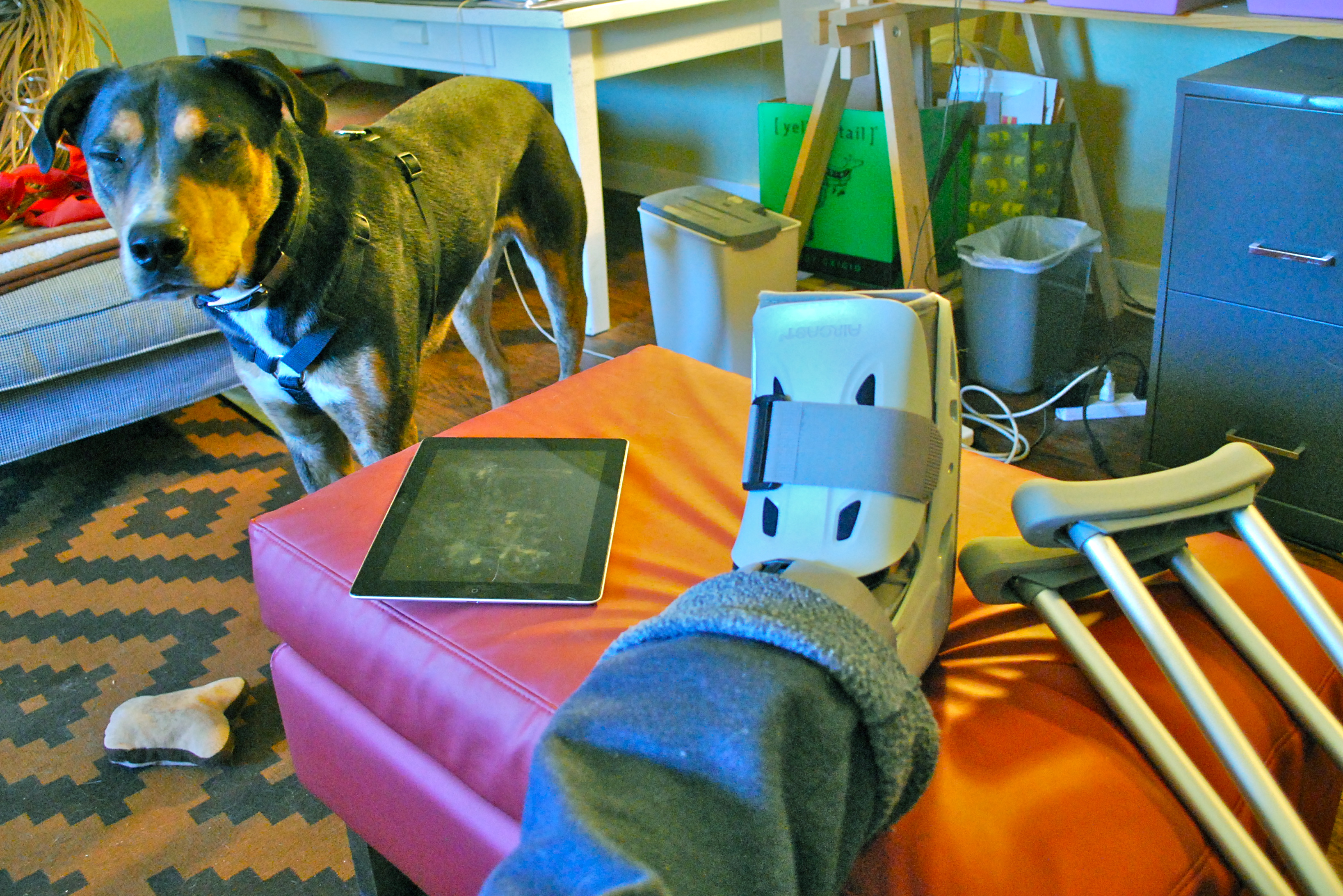
I am very lucky to have help. This past weekend my lovely boyfriend came over and did absolutely everything for me. He cleaned my entire house, did all my chores, took me out to eat when I was hungry and fetched me whatever I required. He set me up with jugs of water in each room and even left me his iPad so I could play my silly games in bed. But alas, dear boyfriend had to go back Sunday night for a week of working on the Mainland.

Just the thought of getting down the back steps today and tackling the barn chores now tires me out. They’ll have to get done one way or another but I’m not looking forward to it. Yesterday I bought an expensive walking cast and the doctor at the clinic seemed to think I could walk on it right away. “You can do away with those!” he said pointing to my crutches. I was relieved, but also skeptical. Turns out I just can’t put my full weight on it so soon and I don’t want to either. The cast still helps a lot though with keeping the foot rigid and keeping the swelling down.

The doctor at Emergency didn’t really give me any helpful info at all. He said I should get a walking cast when the swelling went down and gave me a Dilaudid. Then he told me I could go home and walked away even though I was sitting in a locked wheelchair in the middle of an empty waiting room. I had to twist around, depress the lock on the handle of the chair and concurrently inch myself backwards back to reception with my good foot where the nurse said “Wow you’re coordinated! Those chairs aren’t designed for patients to move themselves.” I told her I figured that out already. She looked at my bare foot and smiled. “Not broken after all?” I told her yes, it was broken but the doctor sent me home. She looked confused and said “He didn’t even give you a splint, nothing at all?” I said no and asked if she would please call me a cab.

Considering I pay about $85 a month for healthcare and haven’t been to the doctor in maybe 5 years, I was pretty underwhelmed by the service at the hospital. They didn’t even have a pair of crutches to loan me so I could get home.

Is it weird that I’ve been training my wolf mix to pick up household objects and hand them to me for the last few months? Was I anticipating this accident somehow? Too bad he can’t take out the garbage.

DSC_0002

Broken Foot

Well it finally happened. After 35 years of never breaking any bones I finally did today. I broke the fourth metatarsal bone in my left foot when I fell into a hole while gardening. A hole I had requested my lovely boyfriend to dig for me just days earlier. Silly me.

I remember a blinding flash of light in my brain when it happened, and I just knew I had fractured something. Until now the worst things I’ve ever really had are a sprained ankle or thumb and various concussions.

There’s no cast, because the doctor at the hospital said that the bone is aligned properly and broken feet swell too much. I am on crutches though, which seemed kind of fun at first until I tried doing my farm chores. You can’t actually carry anything very well while on crutches. Just doing a few simple things is totally exhausting. I can make do outside with a lot of effort and bit of spillage, but how am I supposed to carry things like plates of food or glasses full of liquid while inside? I’m not really sure.

Luckily I know my wonderful boyfriend will help me out as much as he can, but he also lives a two-hour ferry ride away. It will be very interesting to see how well I’ll be able to cope by myself in his absence. I’m very grateful that it was my left foot and not my right, so I can still drive myself around.

This was also a fantastic opportunity to try “knitbone”, another name for the comfrey plant. Comfrey contains something called allantoin, which is a cell proliferative. That means it makes cells regenerate faster. Good thing I have my own little patch beside the chicken coop! I hobbled down and got myself a nice big fresh leaf, minced it very finely and applied it as a poultice to the affected area. It has a nice cooling sensation and a little bit of a stinging feeling. I hope it helps me heal faster.

DSC_0004

The Myth of the Routine in Dogs

IMG_4735

Enjoying the water? Not the routine!

When most people research dogs, they read that dogs love routine. While this is certainly true, it doesn’t mean you have to become a slave to your dog. You need to make your dog’s love for routine work for you, like any good employer!

Dogs live to work. Whether it’s guarding your home, playing with your kids or making you laugh.

I’m an entrepreneur so I have a very variable work week. I could be up until 7am or up until 10pm. I don’t have a typical schedule at all compared to someone who works a consistent 9 to 5. I also have two large dogs and three cats (well currently nine). I used to worry about my pets adjusting to my ever changing schedule, but I soon realized that if I could adjust, then they could too. And it’s a lot less painful that you may think.

What people don’t realize that is that your dog loves any routine you can offer them, and everyone has a routine.

Even the most erratic schedule can become the “routine” for a dog. A dog does not need a routine schedule in the formal sense at all, and I even think it can be beneficial to avoid a set schedule with certain activities like feeding. If you feed your dog every day at the same time, you know what happens. Your dog knows exactly what time it is, they begin to salivate and remind you that mealtime is approaching… I find this annoying. I never really deal with this anymore after implementing my “chaos” training but I know what it’s like. Dogs can become very demanding in situations like these because they know they will be fed no matter what. Because it’s the schedule.

Try feeding your dog on a wholly erratic basis. Some days you should not feed your dog at all. This has the added benefit of not having your dog freak out and have a heart attack if they have to miss a meal for some reason. I often feed my large wolf mix a whole chicken carcass, feathers and everything. I will then usually not feed him the next day. As long as you monitor your dog’s weight closely, you should really only feed when your instincts and your dog tell you the dog looks thin and the dog seems hungry. Dogs and cats (like humans) do not benefit at all from being overfed.

So relax about worrying your new dog will not fit into your routine. It’s possible they truly may not, but if you do your due diligence as a responsible pet owner, it’s more likely your furry friend will adapt to your schedule like a furry chameleon.