Deep Litter Method for Rabbits

DSC_0017.JPG

Mathurine in her deceptively empty cage. She has just demolished a pound of wild greens and the remnants have been folded into the bedding

Lately I’ve been trying something new in my rabbitry, the deep litter method.

Many people use this method with chickens, pigs or cattle; but it isn’t something you would normally think to use with rabbits, unless they’re conveniently on wire like mine.

My cages used to be about a foot off the ground, and this meant I needed to do a thorough cleaning every week. More often if there were growing litters. Most of my bunnies are currently housed over a concrete floor, and I use pine pellet bedding underneath to absorb the urine. This works great because wood pellets require a good nitrogen source to start breaking down properly, and the urine provides that. It creates amazing compost in a very short time.

Not long ago however, I raised my cages up another foot. Not only did this make it easier to clean underneath them, but I noticed that if I just stirred up the litter daily with my garden hoe and kept adding more pellets to wetter areas as needed, that the bedding was beginning to compost under the cages. There was a lovely earthy smell in the barn and pellet use was cut down to about one tenth of what I was using before. The 6″ to 12″ thick layer is also much better at absorbing urine and water spills.

Another added benefit is it’s pretty much ready to go right into the garden once you do finally clean it out. I plan to leave a 2″ layer of old material underneath once I do this, in order to reinoculate the new bedding. I’ve read that commercial chicken farmers actually have a lower mortality rate for new chicks if they are introduced to well-aged deep litter bedding as opposed to a freshly sanitized clean environment, because the good bugs establish slowly and fight off the bad bugs, which establish more quickly. It makes sense to me.

Everything that falls into the bedding gets mixed in and helps the breakdown process along. Hay, straw, bits of vegetation that the rabbits drop, feed pellets, shredded paper and fur. Since I get a lot of free used coffee grounds from the local Starbucks, I sometimes sprinkle a few cups over the top.

In some areas, when I fluff up the bedding I find colonies of maggots. These spots have the blackest and richest looking compost in them, and I will sometimes scoop a bunch of it out and toss it into the chicken coop for the girls to pick through. The maggots are a great and free high protein treat for them.

New Spring Bunnies Part 2

DSC_0016

Opal’s small litter

As predicted, the last two does kindled on Friday and now all our first spring bunnies have arrived.

Fire Opal had a small purebred Standard Rex litter of three, two broken blue/opal and one broken black. Esther had a Creme d’Argent/Champagne d’Argent litter of six. With the bunnies that were born Thursday, that makes a total of 28.

The advantage of having does all due at the same time is I can even out the litter sizes for better survival rates. Most of the kits from these litters are pretty distinct looking, so I’ll still be able to tell who’s who once they mature.

I took four kits from Caraway and added them to Fire Opal’s nest, leaving them both with seven. Then I took one pink kit from Samphire and put it in with Esther’s agouti litter, leaving them both also with seven each. A very reasonable number that each mom should have no trouble taking care of properly.

DSC_0017

Esther’s Argent cross litter

New Spring Bunnies are Here

DSC_0009.JPG

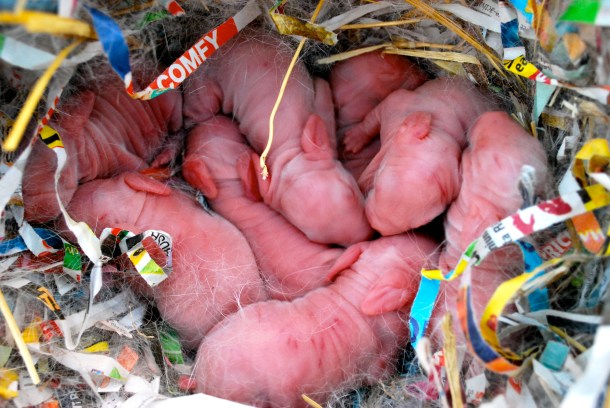
Samphire’s Californian litter. Don’t they look comfy?

I had four does due today, but as of 7pm only two have kindled. I expect the other two will have kits by tomorrow morning.

Samphire threw nine purebred Californian kits, one of which one was found dead in the nest, so a total of eight. Caraway, who is half Standard Rex and half Creme d’Argent, was bred to my new Champagne d’Argent buck Gonzague, and she threw eleven kits, all of which look to be agouti colored.

Tomorrow should bring a litter of purebred Standard Rex, and a litter of Creme d’Argent/Champagne d’Argents. The Argent crosses are new, so I’ll be interested to see what colors result.

Rabbits are being reserved fast, so contact me if you’d like to place a deposit.

DSC_0012

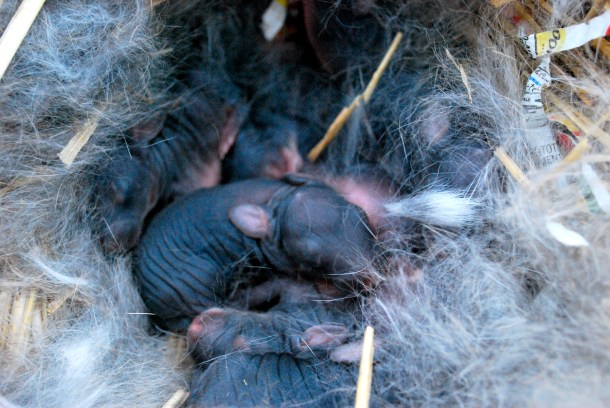
Caraway’s litter. Lots of fur pulled for this nest!


Over Five Pounds at Nine Weeks!?

DSC_0007.JPG

Black triple hybrid buck, 5.31lbs!

When I started with rabbits a few years ago, I was getting very poor grow out rates. I attribute this to the fact that I was trying to stick to purebreds. My Californian rabbits, which are considered to be a top meat breed, probably have the worst grow out rate of all. I don’t think I’ve ever waited long enough for them to reach 5 lbs, and I’ve let them grow for probably up to 16 weeks in the past. The Rexes are a bit better, but are maybe 4lbs at 10 weeks at the most. The purebred bunnies sell well, but they don’t make good meat stock by themselves.

So I’ve been hybridizing. I have only one Creme d’Argent rabbit, and so she has always been bred to either a Californian or a Rex buck. It was easy to see that the resulting hybrid offspring were putting on weight faster, and when she finally had a doe that hit the 5 pound mark at 10 weeks I kept her. That doe is Caraway and she’s half Creme and half Rex. She is 10.5lbs fully grown and looks like a big brown cottontail. Total sweetheart.

After she reached six months of age she was mated to Scorch, my big Californian buck, since she had to be paired with a third breed in order to maintain F1 hybrid vigor. Her first litter only produced five kits, which were a mix of browns and blacks.

DSC_0006

Dark triple hybrid brown buck

These kits have grown so fast I almost can’t believe it, they were nine weeks old on Monday and I weighed them today (Wednesday). The bucks’ weights were 1961g (4.32lbs), 2050g (4.52lbs), 2263g (4.99lbs), and 2410g (5.31lbs)!

DSC_0012

Lighter triple hybrid brown buck

There is only one doe in this litter, a dark brown/black girl. She also happens to be the largest in the litter at 2418g, or 5.33 pounds! That’s just unheard of for a rabbit barely over nine weeks old in my experience.

DSC_0004

Black triple hybrid doe

Introducing: Champagne d’Argents

DSC_0006

We have a new breed here at Abernathy’s!

This lovely young pair of Champagne d’Argents were dropped off today by a very reputable breeder operating out of Victoria. I met her last summer at the Vancouver Island Exhibition, and have been waiting for a suitable pair to become available ever since.

There was a lot of interest in these bunnies so I was very lucky to snatch them up. The buck has even won a grand champion leg already, and of course they are fully papered and pedigreed.

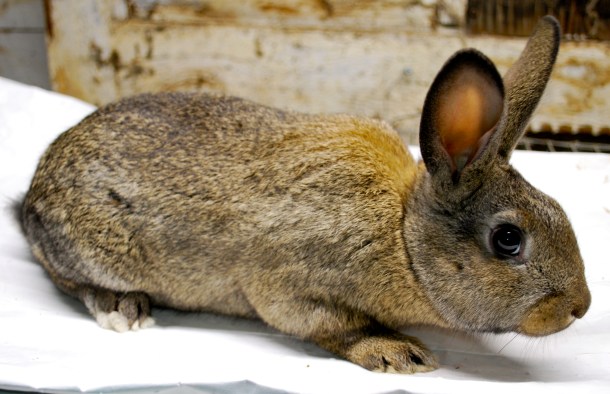
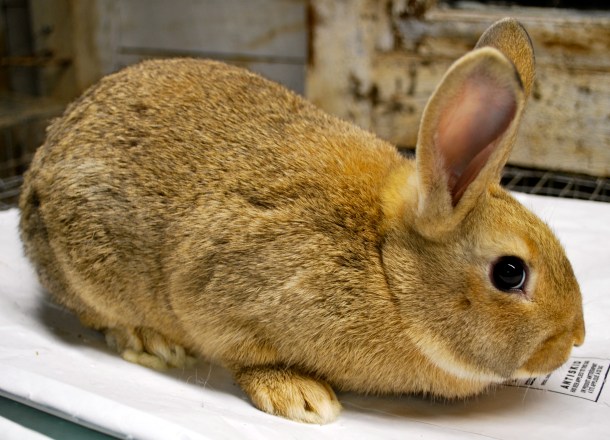
The Champagne d’Argent is an old breed that originated in France almost 400 years ago. Along with the Creme d’Argent, they were initially bred for their fur, but are now bred mainly for meat. They have been called the “black angus” of rabbits and are purported to have a tenderness and flavor that is superior to other breeds, as well as an excellent grow out rate.

They are also great mothers, very calm and sweet rabbits and of course they are beautiful. They do very well on forage which is a big plus for me since I offer a lot of wild greens in the warmer months. This pair do not have names yet, but are already settled into their freshly scrubbed new cages and seem quite content.

I’m now at maximum capacity here and I’ll need to build some new cages soon. I may sell my Californians. They are excellent rabbits with very good personalities, but they were supposed to come with pedigrees and the breeder never provided them. There’s now no way for me to get their papers and unfortunately I only want to deal with fully papered rabbits at this point. We’ll see what happens.

DSC_0002

Broken Rex Kits at 7 Weeks

Okay these kits are just beautiful! DSC_0008

This first photo is of the one solid castor Rex kit who has turned out to be a doe, and will be staying at the rabbitry as a new breeder. Isn’t she lovely? Look at those little fat rolls already developing!

DSC_0007

There is also a darling broken castor doe, a broken black otter doe, and an opal doe. Pictured below:

Of course there are also boys!  A nice broken blue otter buck, a broken opal buck, a broken black otter buck, as well as some false opals and some mismarked black otters. I don’t have photos of these guys because my camera ran out of juice! Rest assured they are as cute as the buns pictured.

Standard Rex Bunnies at 3 Weeks

DSC_0018These bunnies are just about three weeks old now, and very cute. They’re starting to nibble on hay and are adept at jumping out of the nestbox to pester their mothers.

Ironically it seems that my opal doe gave me blues and my blue doe gave me opals.

You can see in the above photo two solid opal kits as well as a broken blue. The opals have the tan undercoat that peeks through the blue while the broken blue does not. There are also two black otter kits, a broken castor and a broken opal pictured above. These are Bluefin’s babies.

DSC_0014This is Opal’s litter. The solid castor kit seems to be a doe, which basically means I have to keep her. The Rex castor coat is just to die for. Also pictured are two broken blues, two broken black otters and a broken castor. Such cute!